
The Mimosa Route: a French Riviera in yellow and gold
When we talk about the French Riviera, we naturally think of the blue of the Mediterranean, the beaches, and the sun. But in winter, another color illuminates the hills: the bright yellow of the mimosa.
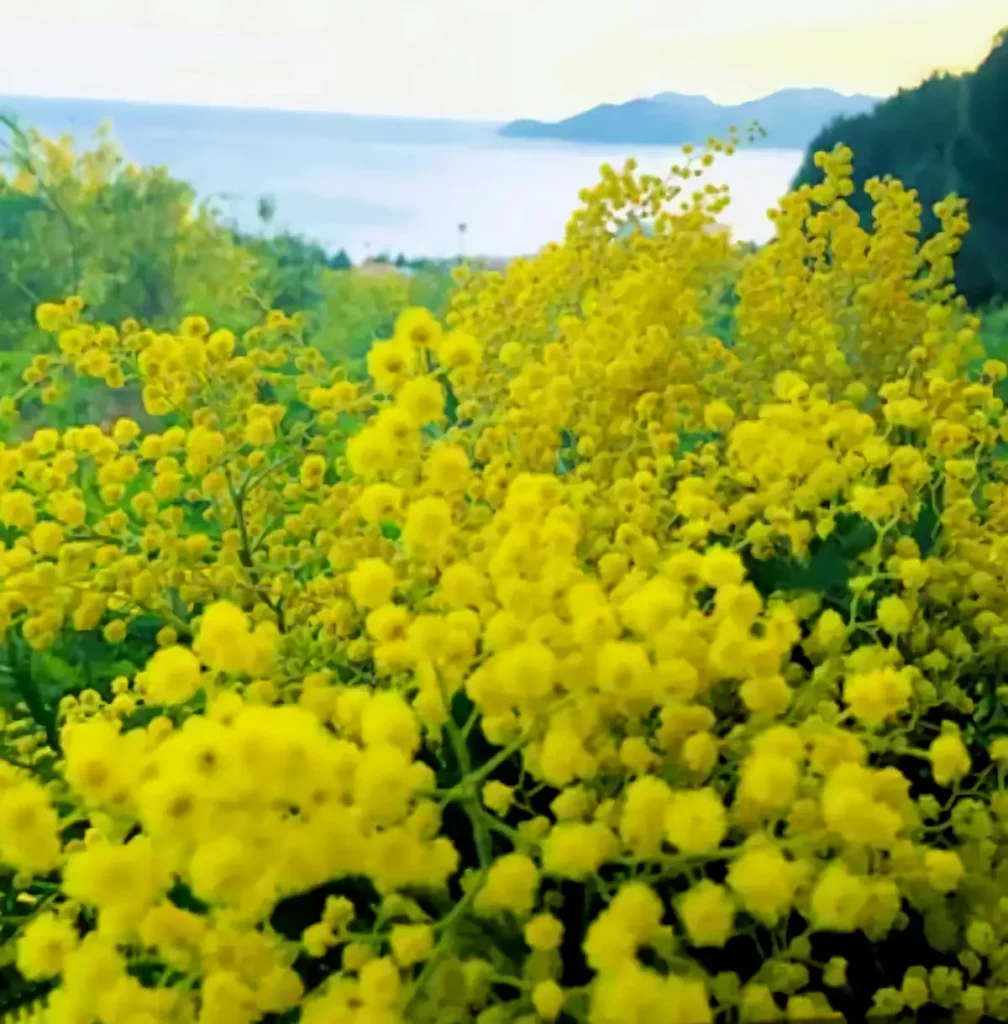
From December to March approximately, golden bouquets transform the landscape. Flowering usually reaches its peak in February, but its exact timing varies depending on the year, weather conditions, and variety.
It is during this season that I invite you to discover the Mimosa Road, an itinerary that reveals a different French Riviera: fragrant, luminous and more tranquil, between coastline, forest massifs and villages of the hinterland.
Mimosa, a flower deeply linked to the French Riviera
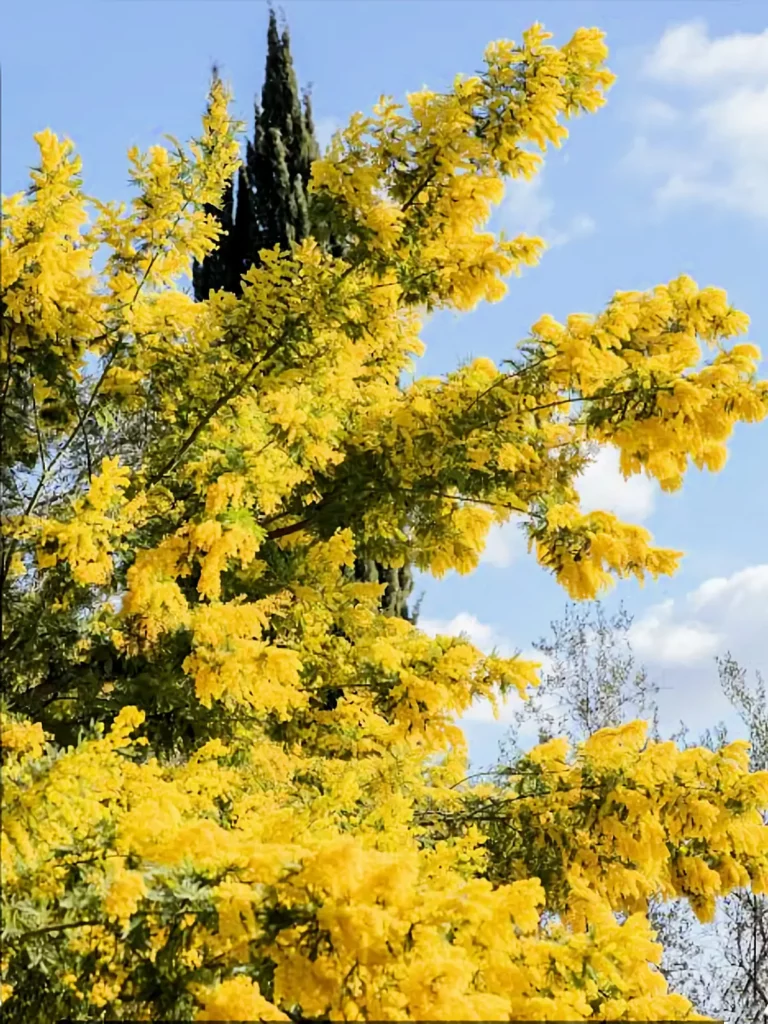
Today, mimosa is an integral part of the French Riviera landscape. However, it is not native to our region: several species came from Australia and have adapted particularly well to the mild climate of the French Riviera.
Our region has a long horticultural tradition, with floral specialties specific to certain areas:
- Grasse : the May rose and jasmine;
- Tourrettes-sur-Loup : the violet;
- Vallauris : orange blossom;
- Mandelieu : the mimosa.
The mimosa is therefore not just a pretty winter flower. It fully belongs to the horticultural and fragrant history of the region.
The Mimosa Route: 130 kilometers between Var and Alpes-Maritimes
The official route connects Bormes-les-Mimosas to Grasse, over approximately 130 kilometers.
It goes through eight stages:
Bormes-les-Mimosas → Rayol-Canadel-sur-Mer → Sainte-Maxime → Saint-Raphaël → Mandelieu-la-Napoule → Tanneron → Pégomas → Grasse.
The route is particularly interesting from January to March, when the mimosa colors the hills. But there's no obligation to cover the entire 130 kilometers in one go.
From Jasmins Studio, The closest stops already allow for the construction of a very nice excursion.
Mandelieu-la-Napoule: the heart of the mimosa
From Jasmins Studio : approximately 15 km and 20 minutes via the A8 motorway.
This is probably where I advise you to start.
Mandelieu-la-Napoule is nicknamed the mimosa capital. Located at the foot of the Tanneron massif, the town has a history closely linked to the cultivation of this flower. The Capitou district, in particular, bears witness to this mimosa tradition.
In Mandelieu, mimosa can be discovered in parks and gardens, on the hills, during walks or at events organized during the season.
But above all, don't just stay in the city: head towards Tanneron. That's where the landscape becomes spectacular.
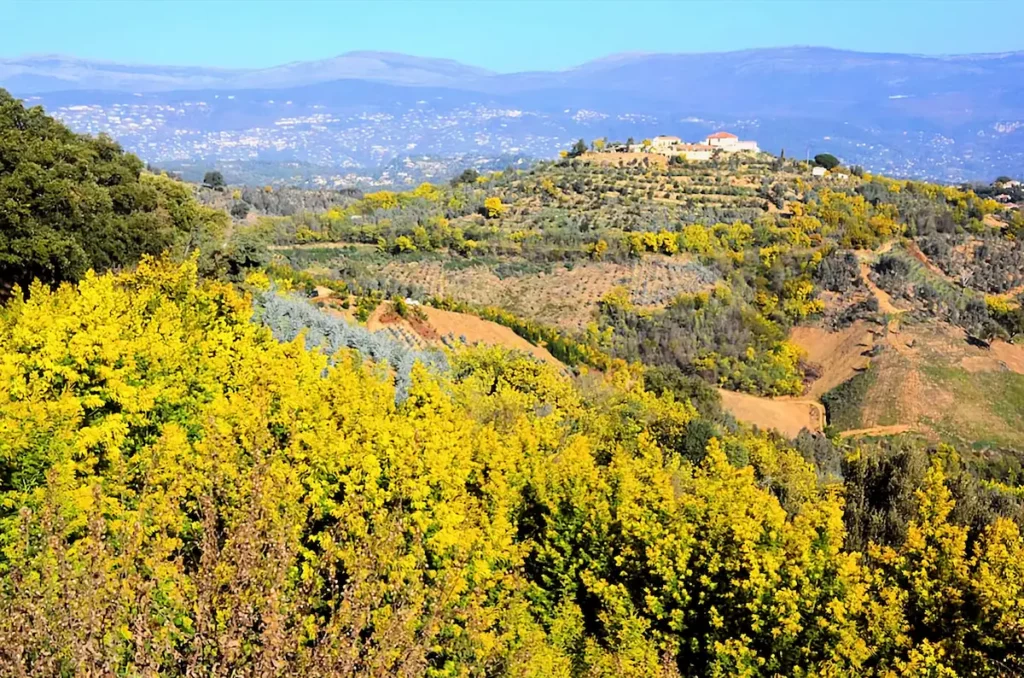
To prepare for a more comprehensive visit, also check out my page dedicated to Mandelieu-la-Napoule: between sea, mimosa and Estérel.
The Tanneron massif: in the yellow forest

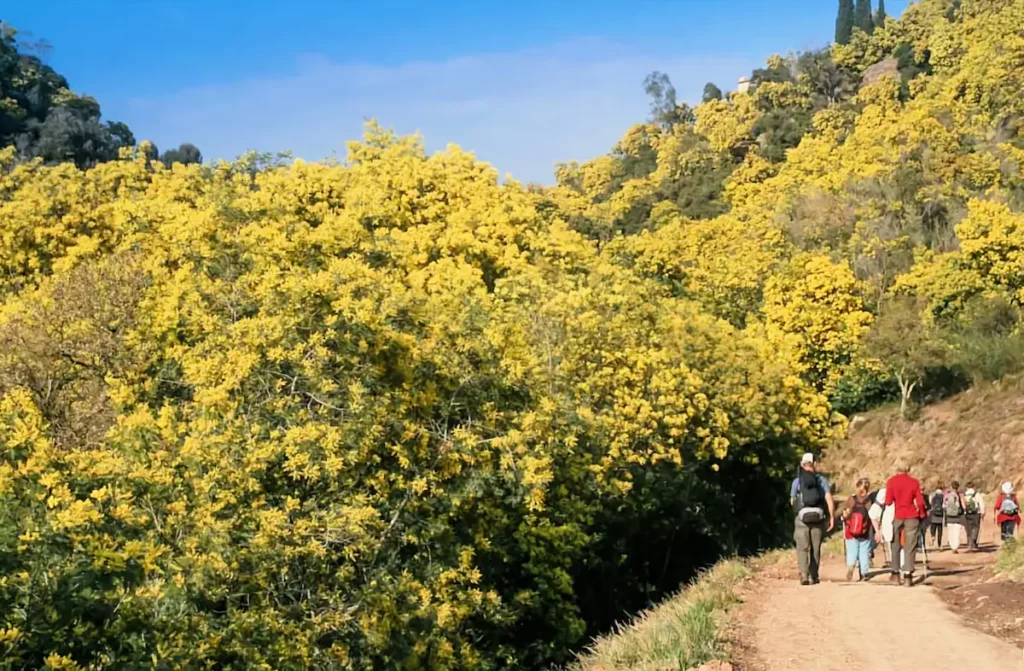
The Tanneron massif is the true heart of the route. It stretches between the Var and the Alpes-Maritimes and constitutes a vast territory of cultivated and wild mimosas.
The hills are covered with yellow flowers, but also with eucalyptus, cork oaks, maritime pines, rockroses and strawberry trees.
On foot or by car?
Both options are interesting.
For a first visit, I advise you to take your time driving on the small roads of the mountain range and to stop when you discover a beautiful viewpoint.
Those who enjoy walking will also find trails allowing them to explore the forest on foot. Some paths start from the Capitou district in Mandelieu.
Warning: Access to some mountain ranges may be restricted during periods of fire risk. Before setting out, check the access conditions.
Tanneron: in the middle of the mimosas
The village of Tanneron is located in the heart of the mountain range to which it gives its name.
It is one of the most interesting stages of the route. It offers beautiful panoramic views of the hills and allows you to discover the work of mimosa artists, these producers who cultivate mimosa for cut flowers or perfumery.
Visits to grow operations, guided walks and meetings with producers may also be offered during the season.
To fully enjoy the flowering season, February is generally the best month. However, flowering can begin as early as December and continue until March depending on the weather conditions.
The mimosa and theEstérel yellow on red
This is where the course becomes particularly spectacular.
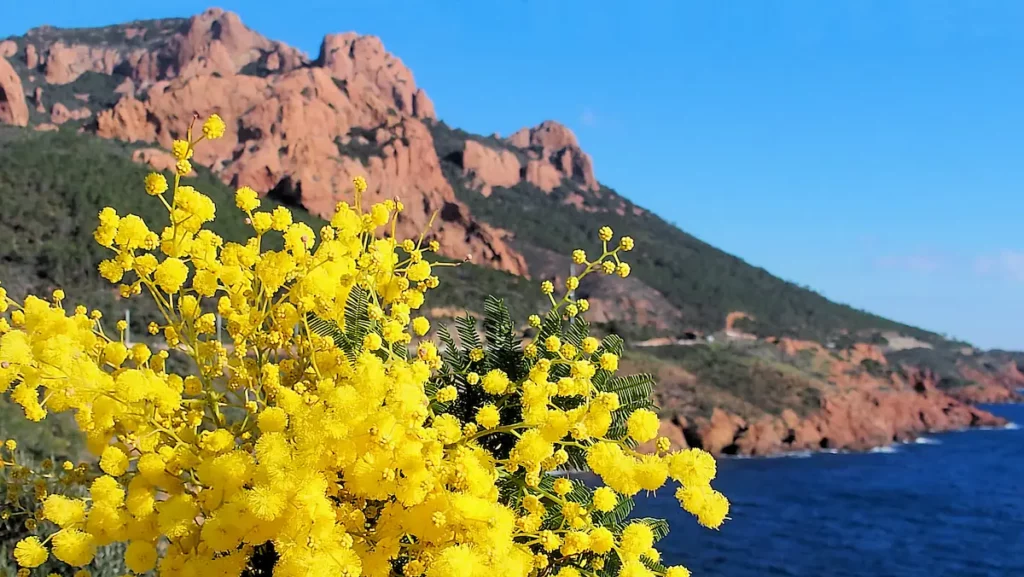
The mountain range ofEstérel It offers its famous red volcanic rocks plunging towards the Mediterranean. Golden Corniche, The road between Saint-Raphaël and Mandelieu-la-Napoule is a remarkable route of about thirty kilometers, between red rocks and turquoise waters.
Now imagine this setting with the yellow bouquets of mimosa!
Red of theEstérel, Mediterranean blue and mimosa yellow: this is probably one of the most beautiful color combinations on the French Riviera.
The Corniche d'Or can therefore be perfectly associated with a day dedicated to mimosa.
To explore these landscapes in more detail, also check out my page on the massif ofEstérel red rocks and the Mediterranean.
Saint-Raphaël: Mimosa between sea and mountain
Saint-Raphaël is another official stop on the Mimosa Route. It is located approximately 36 km and 44 minutes from Tanneron, according to the indicated route.
It is also an excellent gateway to theEstérel, approximately 45 km from Jasmins Studio.
You can therefore imagine a route:
Jasmins Studio → Mandelieu → Tanneron → Saint-Raphaël → Corniche d'Or → return to Jasmins Studio.
And if you love the sea, you can combine this excursion with a walk along the coastline or exploring the small coves of theEstérel.
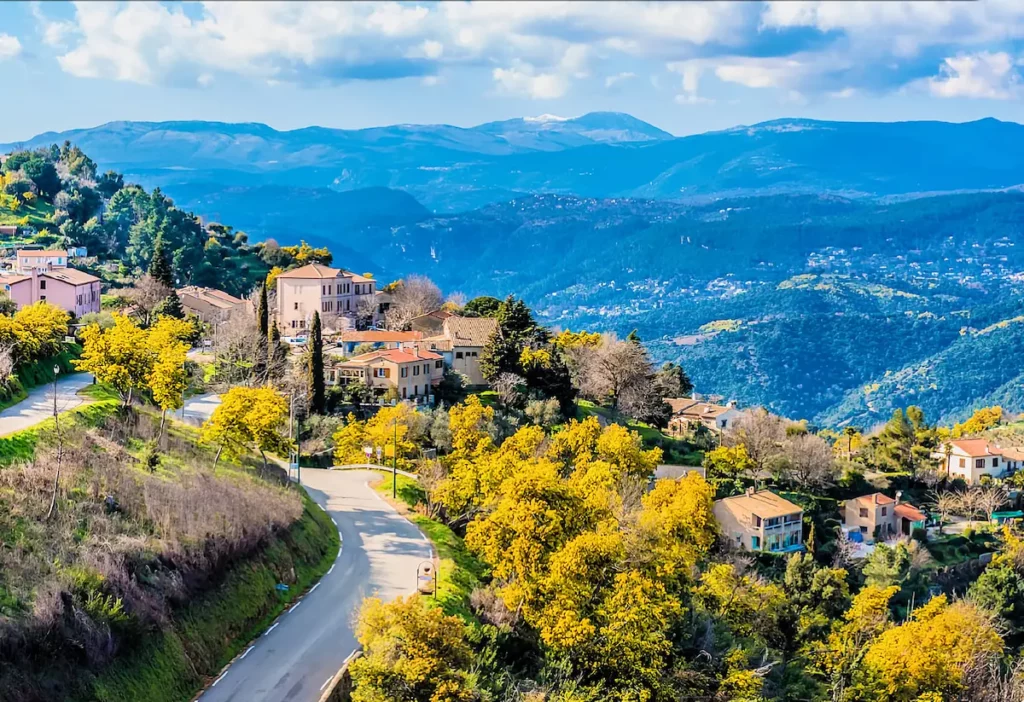
Pégomas: the link with the Grasse region
After Tanneron, the route descends towards Pégomas before reaching Grasse.
This step allows us to make the link with another great story of our region: that of flowers and perfumery.
The mimosa is part of a whole horticultural tradition that has made the Grasse region famous. The May rose and jasmine have contributed to Grasse's renown, while Mandelieu is associated with mimosa and Tourrettes-sur-Loup with violets.
Grasse: the final leg of the journey through the land of perfumes
The Mimosa Route ends in Grasse, the historic capital of perfumery.
It's a beautiful conclusion to the journey: we start with a spectacular flower that we discover in the hills and arrive in a city where flowers have become perfumes, essences and know-how.
You can extend your excursion by exploring the Grasse region: flowers, perfumes and gardens.
And if you'd like to discover a local producer, I also invite you to read my article dedicated to Terroir-06, organic producer of citrus fruits and aromatic plants.
And Bormes-les-Mimosas?
Bormes-les-Mimosas marks kilometer zero of the Mimosa Route. It is therefore the official starting point of the entire route to Grasse.
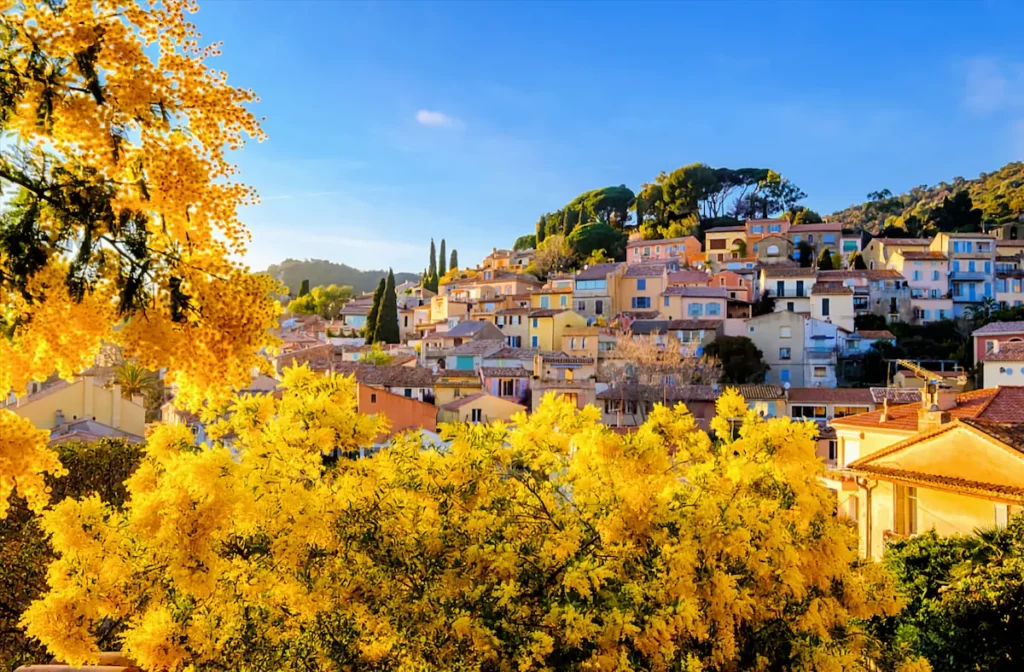
But, at approximately 111 km and 1 hour 50 minutes from Jasmins Studio via the A8 motorway, Bormes is significantly further away than Mandelieu and Tanneron.
I would therefore consider it as a separate excursion, rather than as a step to add to the Mandelieu–Tanneron day trip.
Visiting the village and discovering Estagnol beach also allows you to build a different day around Bormes, the Var coastline and the Giens peninsula.
Find all the details on my dedicated page. Bormes-les-Mimosas and Estagnol beach.
When is the best time to go see the mimosa?
This is obviously the essential question.
The general flowering period extends from December to March, but the timing varies depending on the year and the variety. February is generally the best month to see the Tanneron massif in full bloom.
However, you should avoid considering a date as guaranteed. Before your trip, check the actual state of the flowering, any organized events, and any potential access restrictions to the flowerbeds.
A day on the "Mimosa Route" starting from Jasmins Studio
This is the excursion I would recommend to my guests.
The morning
- Departure from Jasmins Studio towards Mandelieu-la-Napoule.
- Discovering the city and the Capitou district.
- Gradual ascent towards the Tanneron massif.
At noon
- Lunch in the Tanneron area or picnic if the weather permits.
The afternoon
- Walk in the mountains.
- Stops to admire the mimosas and the panoramas.
- Descent towards Saint-Raphaël via theEstérel.
The return
Back to Jasmins Studio via the Corniche d'Or, if traffic conditions and road conditions permit.
In a single day, you will have discovered the mimosa, the Tanneron, theEstérel and the Mediterranean.
Another possibility: follow the entire Mimosa Route
If you have more time, nothing prevents you from following the full itinerary:
Bormes-les-Mimosas → Rayol-Canadel-sur-Mer → Sainte-Maxime → Saint-Raphaël → Mandelieu-la-Napoule → Tanneron → Pégomas → Grasse.
That's about 130 kilometers between Var and Alpes-Maritimes.
But don't try to rush through this route. The whole point of the Mimosa Route is to take the time to look, smell, walk and discover.
The Mimosa Route: a winter excursion
That's perhaps what I like most about this route.
The French Riviera is not just a summer destination. In winter, when temperatures often remain mild, the blue skies and mimosa-covered hills give the region a completely different atmosphere.
The mimosa then transforms winter into spring before its time.
And since Jasmins Studio, You are particularly well placed to go and discover it: Mandelieu and Tanneron are nearby, theEstérel is within easy reach and Grasse allows you to naturally extend the story of flowers and perfumes.
Discover it on the Mimosa Route
- Mandelieu-la-Napoule: between sea, mimosa and Estérel
- The mountain range ofEstérel red rocks and the Mediterranean
- Bormes-les-Mimosas and Estagnol beach
- The Grasse region: flowers, perfumes and gardens