
La Route du Mimosa : une Côte d’Azur en jaune et or
La Route du Mimosa
Another way to discover the French Riviera
When we talk about the French Riviera, we naturally think of the blue of the Mediterranean, the beaches and the sun.
But in winter, another color appears on the hills: the bright yellow of the mimosa.
From December to March approximately, golden bouquets illuminate the landscapes of the French Riviera, with a peak of flowering generally in February.
The exact period varies, however, depending on weather conditions and varieties.
It is during this season that I invite you to follow the Mimosa road.
You will discover a different French Riviera: more tranquil, fragrant, luminous, between coastline, forest massifs and villages of the hinterland.
Mimosa, a flower deeply linked to the French Riviera
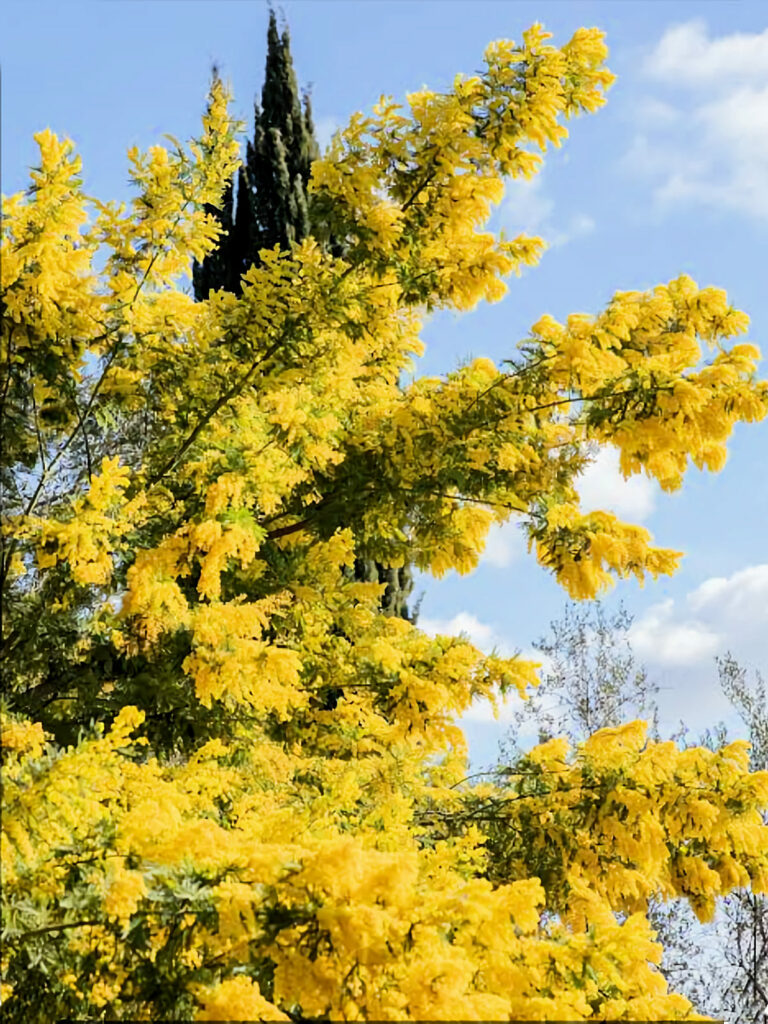
Today, mimosa is an integral part of the French Riviera landscape.
But it is not native to our region: several species came from Australia and have adapted particularly well to the mild climate of the French Riviera.
The flowers in our region are cultivated according to the traditional specialization of the different territories:
- Grasse : the May rose and jasmine,
- Tourrettes-sur-Loup : the violet,
- Vallauris : orange blossom,
- Mandelieu : the mimosa.
Mimosa is therefore not just a pretty winter flower: it belongs to the horticultural and fragrant history of the region.
The Mimosa Route: 130 kilometers between Var and Alpes-Maritimes
THE official route of the Mimosa Route links today Bormes-les-Mimosas to Grasse, a distance of approximately 130 km.
It goes through eight stages: Bormes-les-Mimosas → Rayol-Canadel-sur-Mer → Sainte-Maxime → Saint-Raphaël → Mandelieu-la-Napoule → Tanneron → Pégomas → Grasse.
This route is recommended January to March, when the mimosa transforms the landscape into a succession of yellow and fragrant hills.
But you obviously don't have to travel the 130 kilometers in one go.
From Jasmins Studio, The nearest stops already allow for the planning of a very nice excursion..
Mandelieu-la-Napoule: the heart of the mimosa
From Jasmins Studio approximately 20 minutes – 15 km via the A8 motorway.
This is probably where I advise you to start.
Mandelieu-la-Napoule is nicknamed the capital of Mimosa.
The town is located at the foot of the Tanneron massif, and its history is closely linked to the cultivation of this flower.
The neighborhood of Capitou, In particular, it bears witness to this mimosa tradition.
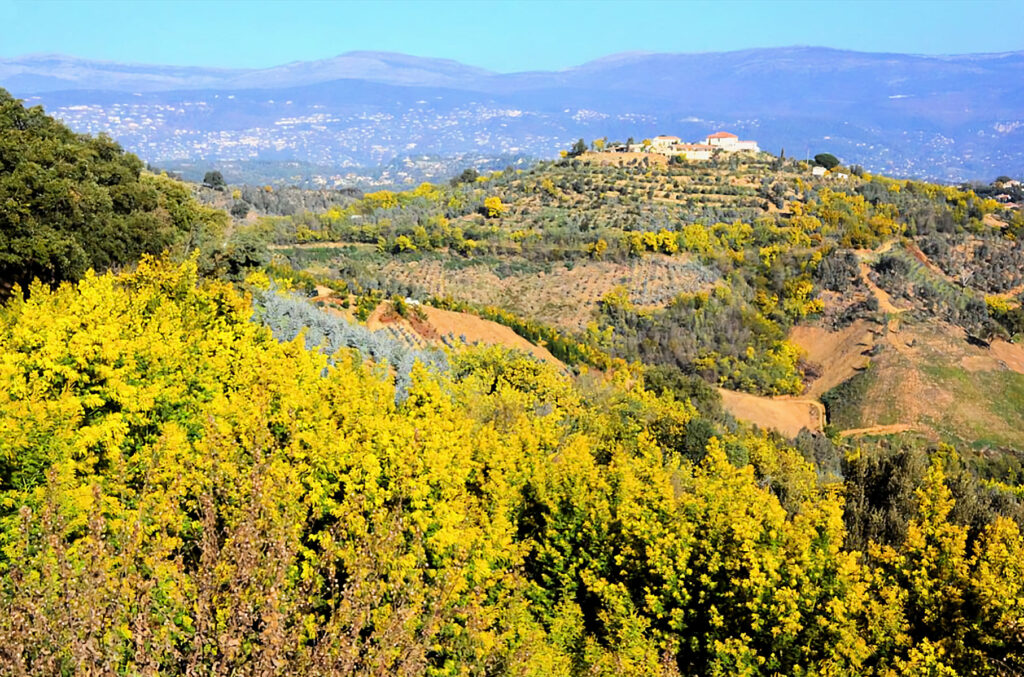
The park and the hills
In Mandelieu, the mimosa can be discovered in different ways:
- in parks and gardens;
- in the hills;
- during walks;
- on the occasion of events dedicated to mimosa.
But above all, don't just stay in the city.
Take the road to Tanneron.
This is where the landscape becomes spectacular.
The Tanneron massif: in the yellow forest
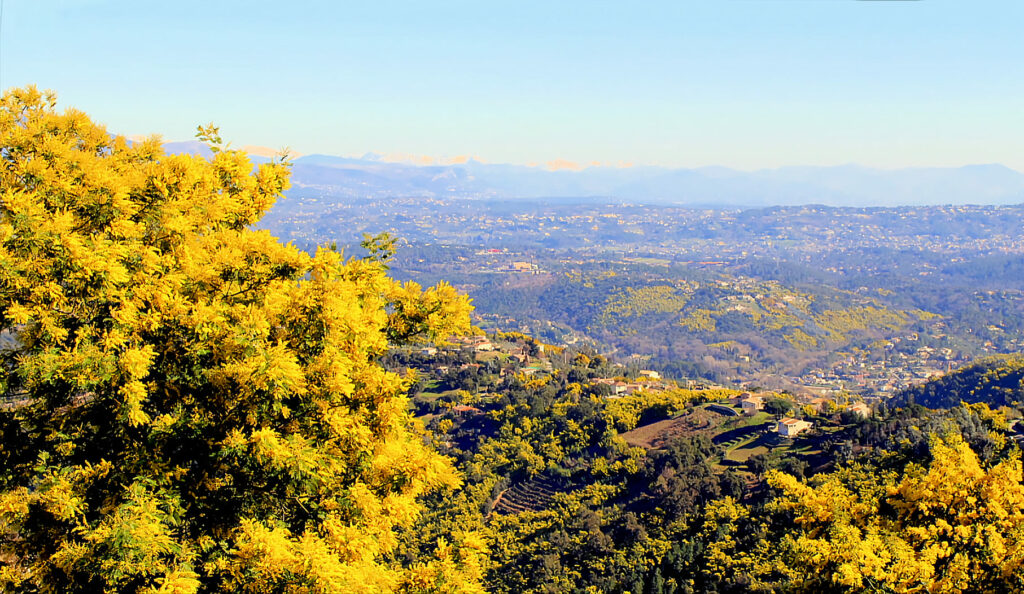
THE Tanneron massif is the true heart of the journey.
It stretches between the Var and Alpes-Maritimes departments and constitutes the largest area planted with mimosa trees in France, with approximately 200 hectares of cultivated and wild mimosa.
The landscape changes completely.
The hills are covered with mimosa, but also with eucalyptus, cork oaks, maritime pines, rockroses and strawberry trees.
On foot or by car?
Both are possible.
For a first visit, I advise you to take your time driving on the small roads of the mountain range, stopping when you discover a beautiful viewpoint.
But walking enthusiasts will also find many trails.
The Mandelieu Tourist Office points out, in particular, paths allowing direct access from the Capitou district to the heart of the mimosa forest.
However, be careful : during periods of high heat or wind, access to certain mountain ranges may be regulated due to the risk of fire.
Tanneron: in the middle of the mimosas
The village of Tanneron is located in the heart of the mountain range to which it gives its name.
This is one of the most interesting stages of the route, located at 22 minutes from Mandelieu-la-Napoule for 12.6 km via the D92 and D138 departmental roads.
The village offers a panoramic view of the hills and allows you to discover the work of the mimosa growers, those producers who cultivate mimosa for cut flowers or for perfumery.
La Route du Mimosa propose également des visites de forceries (ateliers où les mimosistes travaillent le mimosa), des balades guidées et des rencontres avec les producteurs.
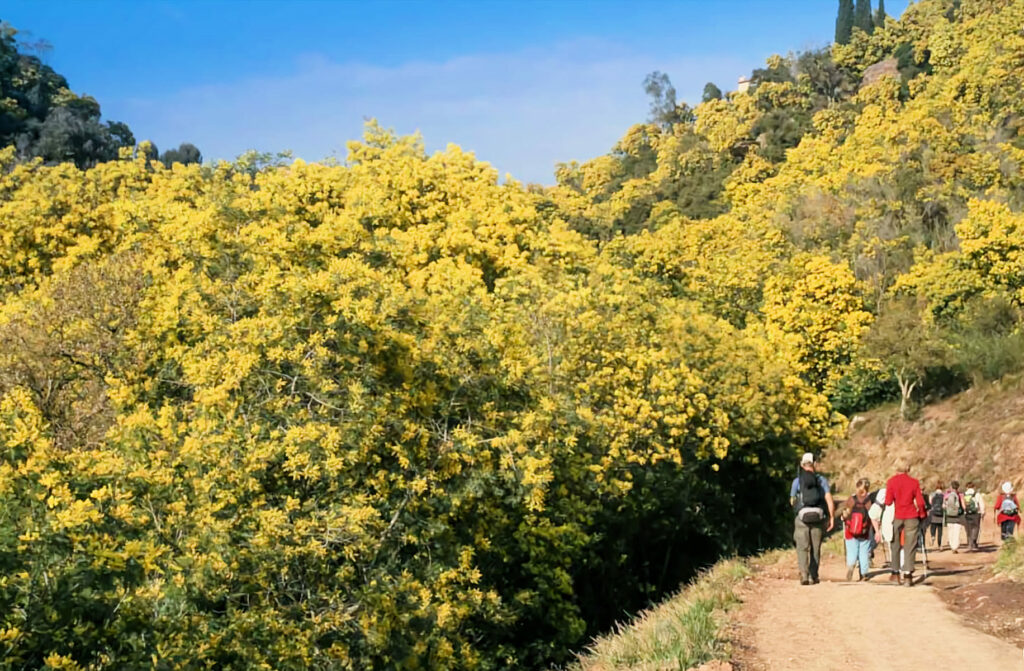
The best time?
To fully enjoy the flowering, February is generally the best month to choose..
But flowering can begin as early as December and continue until March depending on the varieties and weather conditions.
Mimosa and the Estérel: yellow on red
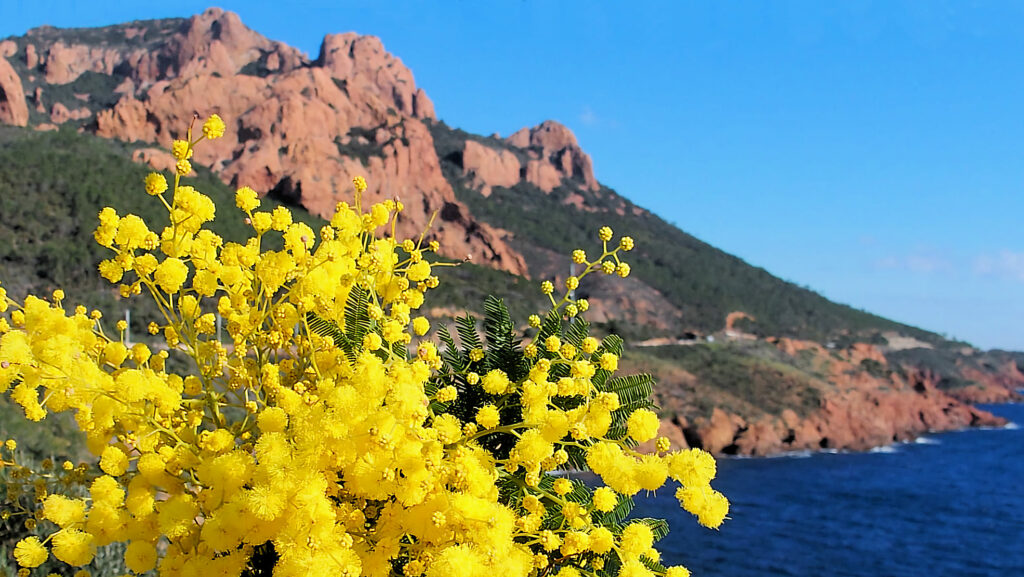
This is where the course becomes particularly spectacular.
The Estérel massif, which we have already presented, offers its famous red volcanic rocks plunging towards the Mediterranean.
There Golden Corniche, The road between Saint-Raphaël and Mandelieu-la-Napoule is a spectacular route of about thirty kilometers between red rocks and turquoise waters.
Now imagine this setting with the yellow bouquets of mimosa.
The red of the Estérel mountains, the blue of the Mediterranean, and the yellow of the mimosa: this is probably one of the most beautiful color combinations on the French Riviera..
The Corniche d'Or can therefore be perfectly associated with a day dedicated to mimosa.
Saint-Raphaël: Mimosa between sea and mountain
Saint-Raphaël constitutes another official stop on the Mimosa Route, at 44 minutes from Tanneron for 36 km via my departmental road D38 and the A8 motorway.
It is also an excellent gateway to the Estérel, located at 43 minutes of Jasmins Studio for 45 km of A8 motorway.
You can therefore imagine a route: Jasmins Studio → Mandelieu → Tanneron → Saint-Raphaël → Corniche d'Or → return to Jasmins Studio.
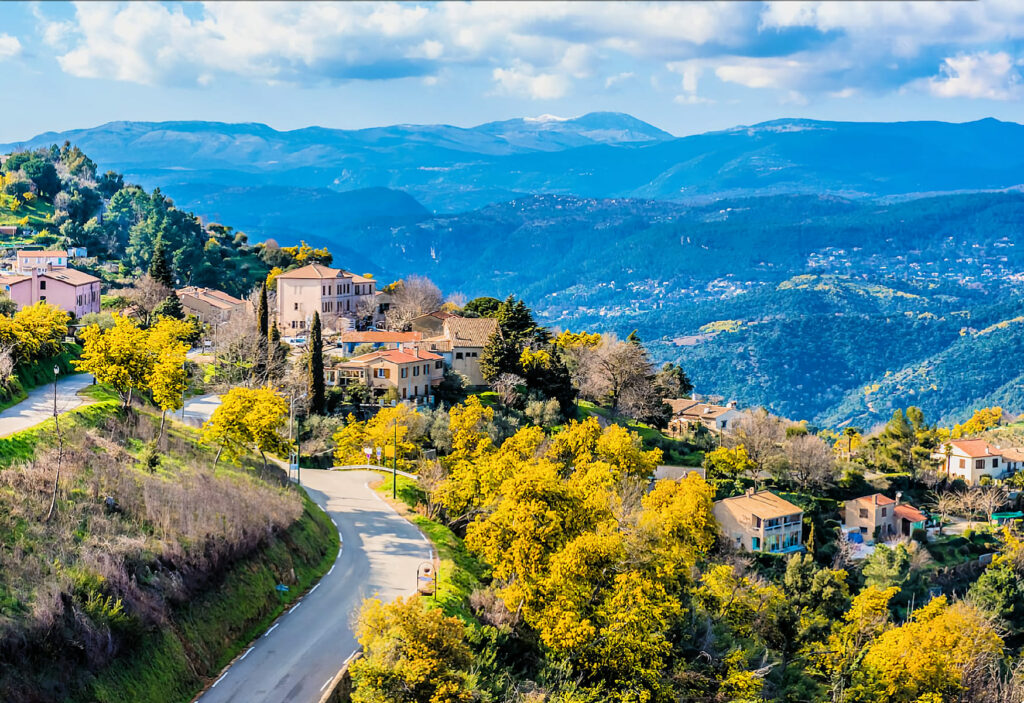
The Route du Mimosa crosses precisely this part of the territory before reaching Mandelieu and the Tanneron.
And if you love the sea, you can combine this excursion with a walk along the coastline or a discovery of the small coves of the Estérel.
Pégomas: the link with the Pays de Grasse
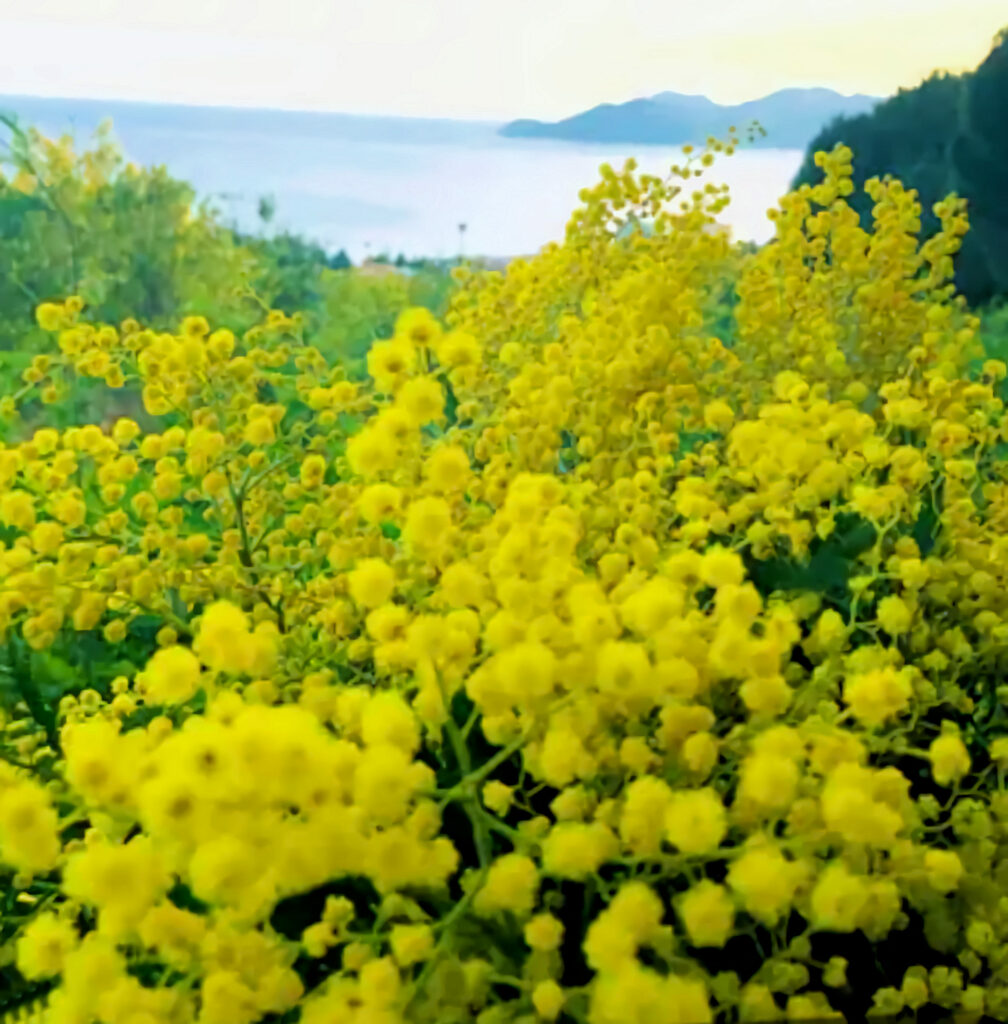
After Tanneron, the route descends towards Pégomas before heading to Grasse.
Pégomas is at 18 minutes from Tanneron for 9.4 km via the D38 departmental road and Route d'Or or D309.
This step is interesting because it allows us to make a connection with another major story in our region: that of flowers and perfumery.
The mimosa is part of a whole horticultural tradition that has made the Pays de Grasse famous.
We have already seen that Grasse was historically associated with the May rose and jasmine, while Mandelieu was the territory of the mimosa and Tourrettes-sur-Loup that of the violet.
Grasse: the final leg of the journey through the land of perfumes
The Mimosa Route ends at Grasse, the world capital of perfumery, 16 minutes for 9.6 km via the D609 departmental road.
It's a beautiful conclusion to the journey.
We start with a spectacular flower that we discover in the hills and arrive in a city where flowers have become perfumes, essences and know-how.
You can therefore extend your excursion by exploring the Pays de Grasse and its gardens.
→ See also: “ The Grasse region: flowers, perfumes and gardens »
And if you'd like to discover a local producer, I also invite you to consult my article dedicated to Terroir-06, which we have already discussed.
And Bormes-les-Mimosas?
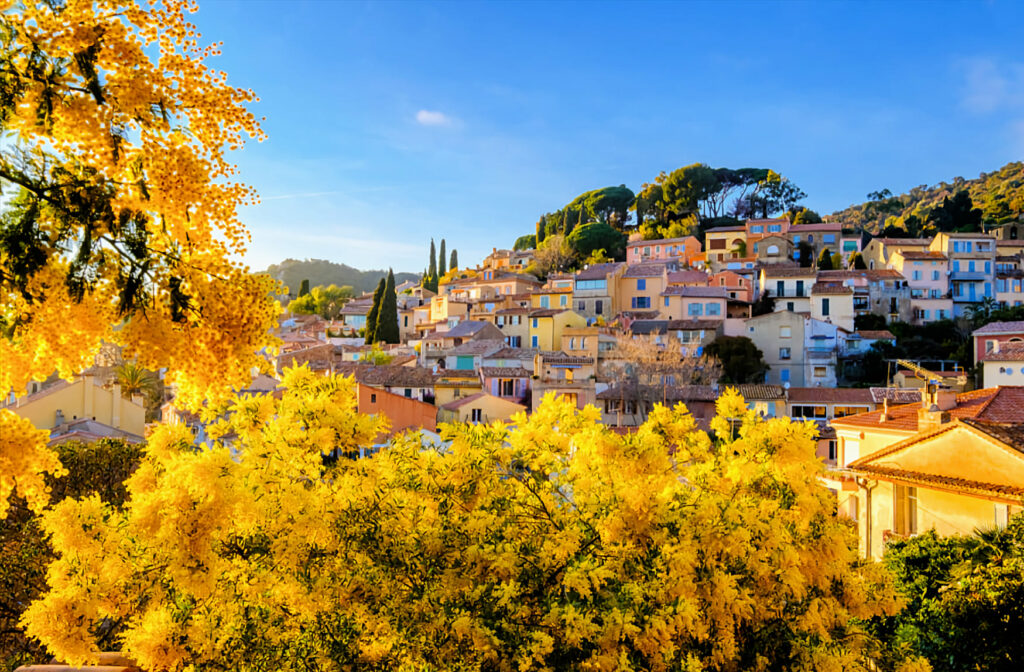
Bormes-les-Mimosas constitutes kilometer 0 of the Mimosa Route.
This is therefore the official starting point of the complete route to Grasse.
But to 1 hour 50 minutes ago Jasmins Studio for 111 km via the A8 motorway, Bormes is significantly further away than Mandelieu and Tanneron.
I would therefore consider it as a separate excursion, rather than as a step to add to the Mandelieu–Tanneron day trip.
Going to Estagnol beach can also allow you to build a different day around Bormes, the Var coastline and the Giens peninsula.
→ Voir aussi : « Bormes-les-Mimosas et la plage de l’Estagnol »
When is the best time to go see the mimosa?
This is obviously the essential question.
The general flowering period extends from December to March, but the timing varies depending on the year and the variety.
February is generally the best month to discover the Tanneron massif in full bloom.
Therefore, a flowering date should not be considered a guarantee.
Before your excursion, find out about the actual state of the flowering and any possible restrictions on access to the flowerbeds.
For 2026, official tourist information indicated, for example, an opening period for the Mimosa Route from January 9 to March 8, 2026, with activities and tours organized during this period.
A day on the "Mimosa Route" starting from Jasmins Studio
This is the excursion I would recommend to my guests.
Morning
Jasmins Studio → Mandelieu-la-Napoule
Discovering Mandelieu and the Capitou district.
Then a gradual ascent towards the Tanneron massif.
Noon
Lunch in the Tanneron area or picnic depending on the weather.
Afternoon
Walk in the mountains.
Take the time to stop and admire the mimosas and the panoramic views.
Then go back down towards Saint-Raphaël through the Estérel.
Back
Back to Jasmins Studio via the Golden Corniche, if traffic conditions and road conditions permit.
In just one day, you will have discovered: mimosa → Tanneron → Estérel → the Mediterranean.
Another possibility: follow the entire Mimosa Route
If you have more time, nothing prevents you from following the full itinerary:
Bormes-les-Mimosas
↓
Rayol-Canadel-sur-Mer
↓
Sainte-Maxime
↓
Saint-Raphaël
↓
Mandelieu-la-Napoule
↓
Tanneron
↓
Pégomas
↓
Grasse
That's about 130 kilometers between Var and Alpes-Maritimes.
But don't try to complete this circuit at full speed.
The principle of the Mimosa Route is precisely to take the time to look, smell, walk and discover.
The Mimosa Route: a winter excursion
That's perhaps what I like most about this route.
The French Riviera is not just a summer destination.
In winter, when temperatures often remain mild, the blue skies and mimosa-covered hills give the region a completely different atmosphere.
The mimosa then transforms winter into spring before its time..
And since Jasmins Studio, You are particularly well placed to go and discover it: Mandelieu and Tanneron are very close, the Estérel is within easy driving distance, and Grasse naturally allows you to continue the story of flowers and perfumes..
À découvrir sur la Route du Mimosa :
→ Mandelieu-la-Napoule : entre mer, mimosa et Estérel
→ Le massif de l’Estérel : roches rouges et Méditerranée
→ Bormes-les-Mimosas et la plage de l’Estagnol
→ The Grasse region: flowers, perfumes and gardens
Also worth discovering:
→ Cannes: the must-sees
→ The most beautiful hilltop villages of the French Riviera
→ The Napoleon Route from Golfe-Juan